Showing posts with label books. Show all posts

Wednesday, May 07, 2008

Books - Managing Humans

Not often do I read a book as funny about management than this one. I've read the Mythical Man-Month, PeopleWare but those books were quite insightful, but d-r-y. This book was refreshing because the point of view is from someone who's lived through the industry.

There's a lot of biting humour and the thing I got from it is that people are not broken down into simple categories. Management from a producer or consumer perspective is "an art", and this book tries to convey that message. Anyone trying to manage people or if you're being managed by someone else, try this book out before the two I mentioned above. Again, I think it has taken the best parts of the dry books and distilled it down into a semi-fictional, funny and witty book.

The chapters are broken into small manageable chunks that you could work through over a quick period of time. I read the book in a few nights. Here's a quick sampling of the chapters:
  • Ch. 1 - Don't be a prick
  • Ch 18 - Status reports 2.0
  • Ch 25 - A nerd in the cave
  • Ch 31 - Rules for the reorg
Let me know how it goes if you end up reading it because of this post.

Tuesday, April 29, 2008

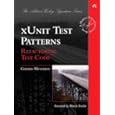
xUnit Test Patterns

I picked up a copy of a new book called xUnit Test Patterns

Some of the developers I have given it to have said it was like gold to them with the help from Design Patterns

Built with a similar structure as the Design Patterns, the reference material at the front and back covers helped to fill in the gaps. The inside front cover shows the design patterns used to create xUnit fixtures and suites. At the back is something completely different - its like a Q&A of when people talk to you about why they can't put xUnit into their applications. My favorite section is "Legacy code cannot be automatically unit tested". Page 365, BAM! Often when I use this lookup, it start a discussion with a developer to begin thinking differently.

Its a nice all encompassing view of how to unit test applications. Although its not new, its nice to have it one place. I think these are one of those books that will be good 10 years from now because of the solid use of patterns over technologies. I'm not a fan of having a huge reference guide for many languages. I use pocket references mostly when I need reference material (or just look it up online). Its a very nice indispensable tool to look up all the different types of unit test structures and patterns in one easy location.

Check it out the reviews for yourself.

For quick reference, here are comments on some of the chapters:

  • Chapter 2: Test Smells - I like this chapter because it explains why code smells and how to recognize where to apply tests

  • Chapter 3: Goals of Test Automation

  • Chapter 7: xUnit Basics - this has saved me a few times now on having to explain to developers how to integrate unit tests into legacy applications. I'm sure I'll get some more running ground on this chapter in the next few years

  • Chapter 25: Database Patterns - this is something I have not got a lot of ground on. People still tell me they cannot abstract out databases. I don't believe you need to, you just should consider the contents of this chapter in order to unit test your database.
To get a copy for yourself, you can order it online or take a look at the online version for free. Again, I like free stuff, so go and educate yourself for free!

Sunday, April 27, 2008

Books - Geekonomics

Here's a book you should avoid. Geekonomics: The Real Cost of Insecure Software and how it supposedly gives you the idea that software is like any other commodity out there.

I recently obtained a free copy of this book and thought "wow, I like free stuff, I might as well give it a read". Well, after a few nights of reading it, I came to the conclusion that this book was meant for those who don't develop software and for someone who only wants to understand how most of their life is ruled by how bad software works within their own lives.

My first reaction was "apparently, we don't test 'our' software enough". This wasn't the author's take, instead he was relating it directly to negative economic and business impacts (which are still true for bad software).

The analogy's used were nicely told; the one story that sticks out in my mind was about how cement/concrete was standardized. Basically, the moral of the cement standardization was that testing was rigorous and people held to that standard for testing it. However, where the author goes awry is when he says the same style of standardization should be applied to software development. I disagree with this statement because software if infinitely more complex than concrete or automobile manufacturing.

The moral of the story is that poor quality controls leads to a economic loss, which in turn hits the bottom line.

Also, don't be fooled by the title, its not that geeky. This is geeky.

Thursday, April 24, 2008

The one that started me off - the Pragamatic Programmer

Every software developer should read this book. The perspective is interesting because it comes from someone who decided to write down the lessons he learned after working for 10 years. Lots of simple advice that schools don't promote. In fact, most of the advice lends itself well to people who have worked for a few years and now want to learn how to get better at what they do.

In general, it gave me a language to speak to senior developers, project managers and managers. The book is broken down in to "tips" and how to handle many different situations. I have a copy at my desk so that I can refer to things (at least the table of contents). Its by no means a bible for software development, its a nice book to have when faced with problems that are common in the industry.

There are a series of books available and another group I would recommend is the Pragamatic Project Automation, version control and unit testing series.

The idea of this post wasn't to sell you on books, it was to expose you to the whole library of pragmatic books out there. Take a look at Amazon for reviews before you purchase since they tend to have more in-depth ideas behind each book.

From a testing perspective, this is where a dovetail occurs. If I understand how developers should think, then I should be able to communicate to them things they may forget to do. In turn, I can help implement and change the organization for the better based on some basic fundamental ideas. This book is a landing platform for me to start this conversation.

So, go find out more. Over the next few posts, my books will become more testing oriented, some more obvious than others (aka: I'll throw a few curve balls, just to see what you think).

Sunday, April 20, 2008

My bookshelf

This is my current bookshelf.


This picture is some of the books I'm reading now. Except for the Da Vinci Code which my wife sneaked on to my shelf, this is what I'm reading right now. Why do I read so many books at the same time?

Back in University, I spent a good part of my time reading. Most of the time the books were technical or contained information that was good for long term references. Occasionally I got to put some fiction in there, but mostly it was school related. There was a lot of concurrent reading going on and it kept me quite interested. One of the few books from school I still refer to is the design patterns book I used in 4th year.

I used to love going to a coffee shop and reading a novel, or a non-fiction book. My preferences were towards the non-fiction like biographies or technically oriented.

After leaving school, I had an allergic reaction to reading. I didn't enjoy it the same way I used to, for which I blame on having way too much non-useful reading to do. It took me some time to get back to a place were I'm reading stuff I enjoy.

So, in order to keep me interested in what I'm reading, I'll put one or two books out a night and read a bit from each. There are some that are always in constant rotation and I read a few pages from each night.

Over the next few posts, I'll be sharing with you my reading collection in relation to software development. I'll try not to bore you with details but give you the reason why you should be reading these books. These are books I think are a must have (unless I say otherwise) for anyone in software development. This isn't limited to testers, but anyone from project managers to developers.